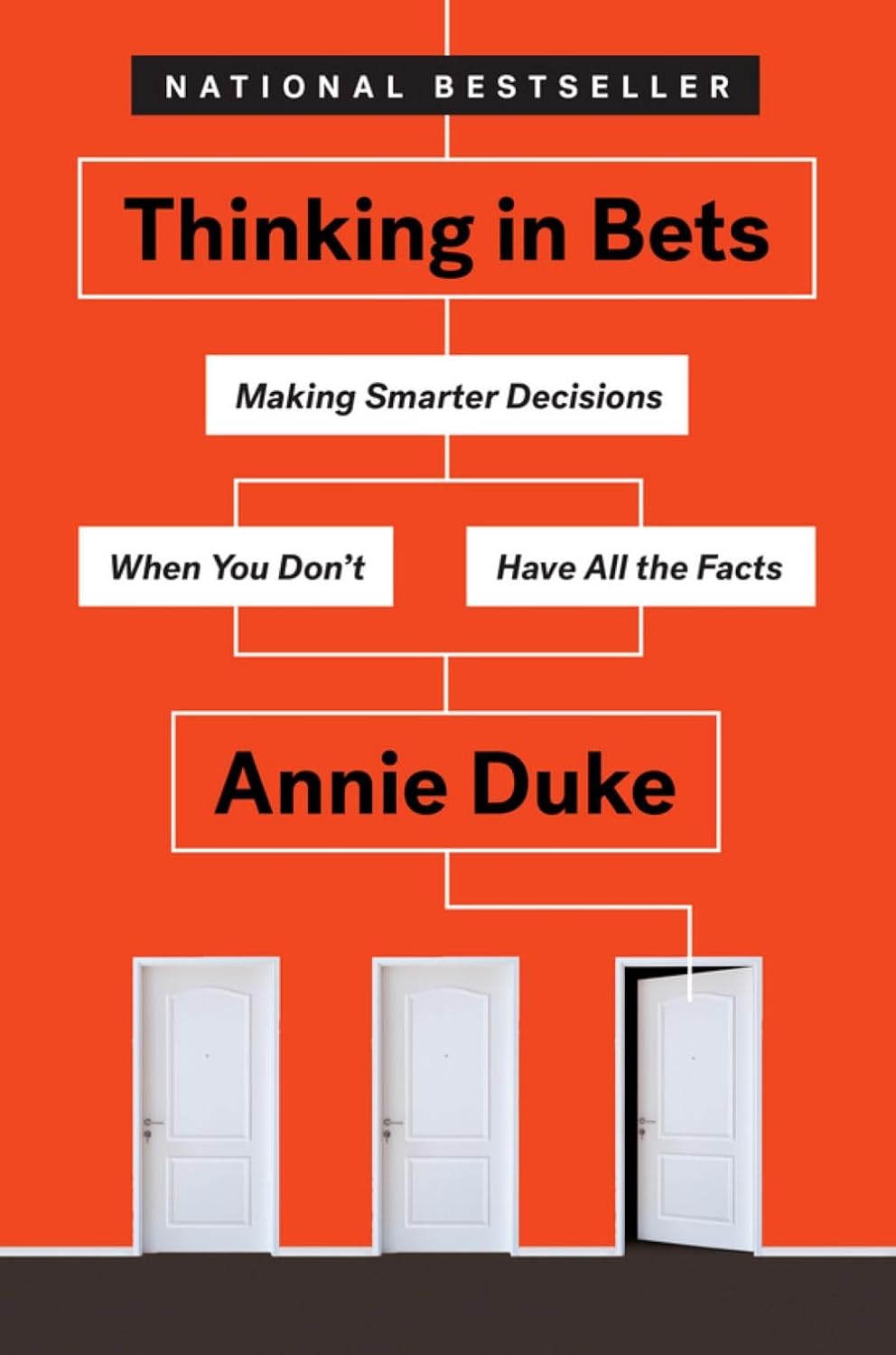
We often judge the quality of our decisions by the outcomes they produce. A successful outcome reinforces our belief that we made the right decision, while an unsuccessful outcome makes us question our judgment. In Thinking in Bets, Annie Duke, a former professional poker player, challenges this approach and explains how embracing uncertainty, questioning our beliefs and thinking probabilistically can help us make better decisions.
All Decisions Are Bets
We routinely choose among alternatives, commit resources, assess the likelihood of different outcomes and consider their potential value. Every decision commits us to a course of action while eliminating other alternatives. Even choosing not to act is a bet. In essence, we are betting against all the future versions of ourselves that we are not choosing.
One of the fundamental challenges in decision-making is Resulting: Our tendency to equate the quality of a decision with the quality of its outcome. A good decision can produce a bad outcome, just as a poor decision can produce a good outcome. Luck and factors beyond our control influence results.
Closely related is Hindsight bias: The tendency, after an outcome is known, to see the outcome as having been inevitable. Once we know what happened, we construct explanations that make the outcome appear predictable, overlooking the uncertainty that existed when the decision was made.
Beliefs, Biases and Uncertainty
Our decisions are based on our beliefs, but how do we form these beliefs? The book explains that the process often follows three steps:
- We hear something.
- We believe it to be true.
- Only sometimes, if we have the time or inclination, do we evaluate whether it is actually true or false.
This makes us vulnerable to Motivated Reasoning: A cognitive bias where people unconsciously process information, filter data, and construct arguments to arrive at a pre-favored conclusion rather than an objective one.
Interestingly, being smarter does not necessarily protect us from bias. It can make the problem worse. The smarter we are, the better we may become at constructing narratives, rationalising evidence and framing information to support our existing beliefs.
The solution begins with probabilistic thinking—recognising that our beliefs are rarely absolutely right or wrong, but have different degrees of confidence.
The book challenges the conventional understanding of confidence. We often assume that expressing uncertainty makes us appear less credible. In reality, the opposite can be true. Consider two people. One declares that something is absolutely true. The other says, “I believe this is true, and I am 80% confident.” The second person demonstrates thoughtfulness and self-awareness by acknowledging the limitations of their knowledge.
Confidence is not about being certain. It is about understanding how certain we should be. Acknowledging that decisions are bets based on our beliefs, becoming comfortable with uncertainty and moving away from binary right-or-wrong thinking are essential to better decision-making.
Learning from Outcomes
To improve our decisions, we must learn to distinguish between skill and luck. The book encourages us to examine outcomes without automatically taking credit for success or assigning blame for failure.
This requires overcoming self-serving bias, our tendency to attribute positive outcomes to our abilities and negative outcomes to external circumstances.
Alternative hypotheses and perspective-taking help us challenge our interpretations. Instead of asking only why our explanation is correct, we should consider what other explanations might account for the same outcome.
Changing these habits requires deliberate effort. Habits operate through a neurological loop of cue, routine and reward. To change a habit, we can retain the existing cue and reward while replacing the routine.
The first step is identifying the habit of mind we want to reshape. For example, when confronted with an unfavourable outcome, instead of immediately defending our decision, we can develop the routine of asking what we knew at the time, what we could reasonably have anticipated and what role luck played.
This changes our objective from proving ourselves right to learning.
Better Decisions Through Groups
Individual thinking is limited by our biases. A well-functioning group can help us examine our beliefs more objectively, provided it encourages disagreement rather than simply reinforcing existing opinions.
The book distinguishes between two approaches:
- Confirmatory thought promotes a love and celebration of one’s own beliefs, distorting how the group processes information and works through decisions. This can result in groupthink.
- Exploratory thought, on the other hand, encourages open-minded and objective consideration of alternative hypotheses, along with a tolerance for dissent to combat bias.
For groups to improve decision-making, consider three important elements: Accuracy, Accountability and Diversity. Incorporating these into the group’s charter creates an environment where members are encouraged to pursue the truth, take responsibility for their reasoning and consider different perspectives.
The book also introduces CUDOS, a set of principles that support productive disagreement:
- Communism: Data belong to the group and should be shared openly.
- Universalism: Apply uniform standards to claims and evidence, regardless of their source.
- Disinterestedness: Remain vigilant about conflicts of interest that could influence evaluations.
- Organised Skepticism: Encourage critical discussion, questioning and dissent.
These principles reinforce an important distinction: The purpose of disagreement is not to win an argument, but to improve the quality of our decisions.
Thinking About Our Future Selves
Our immediate emotions often influence decisions more than their long-term consequences. By bringing our future self into a decision, we can consider how our present choices might affect us later.
One particularly useful technique is moving regret in front of a decision. Rather than experiencing regret only after an unfavourable outcome, we anticipate what might go wrong before deciding. This has several benefits. It can help us make better decisions, prepare responses to negative outcomes and treat ourselves more compassionately when things do not work out as expected.
This is particularly important in avoiding Tilt, a term from poker describing how a bad outcome can trigger emotional reactions that compromise subsequent decisions. Those irrational decisions can produce further negative outcomes, creating a destructive cycle. Recognising the possibility of tilt allows us to establish responses in advance rather than reacting emotionally in the moment.
Backcasting and Premortems
There are two complementary techniques for improving decisions by imagining possible futures.
- Backcasting starts by imagining a successful future and working backward to identify the decisions, actions and conditions necessary to achieve it.
- Premortems take the opposite approach. We imagine that our decision or initiative has failed and work backward to understand what might have caused that failure.
Backcasting helps identify the path to success, while premortems expose risks, assumptions and potential obstacles. Together, they help us prepare for different outcomes rather than assuming that our preferred future will inevitably materialise.
Thinking in Bets offers a different perspective on decision-making. It challenges us to recognise that uncertainty is unavoidable, that our beliefs are often less reliable than we assume, and that outcomes alone cannot determine whether a decision was good or bad.
For leaders, the implications are particularly relevant. Better decisions require intellectual humility, probabilistic thinking, openness to dissent and a willingness to challenge our own beliefs. Creating an environment that values accuracy over agreement and learning over blame can significantly improve the quality of collective judgment.
We cannot control every outcome, but we can improve the quality of the decisions we make.